
Guide to Pesticides in Produce - Natural Life Magazine January/February 2004: "Guide to Pesticides in Produce
The Washington D.C.-based Environmental Working Group (EWG) has analyzed over 100,000 U.S. government pesticide test results and found 192 different pesticides on 46 popular fresh fruits and vegetables. At the same time, they have created a new Shopper�s Guide to Pesticides in Produce so that consumers can shop their way to reduced pesticide exposure.
Stonyfield Farm, the world�s largest organic yogurt manufacturer, created the convenient wallet-size Guide to deliver this information to consumers. Downloadable from both www.foodnews.org and www.stonyfield.com, the Guide lists the 12 produce items that are consistently most- and least-contaminated with pesticides.
Consumers who are concerned about eating pesticides can either buy organic produce or use the Shopper�s Guide to choose conventional foods that contain the least pesticide residues. Using this tool can reduce the number of pesticides in produce a person eats by up to 90 percent. "
Tuesday, December 20, 2005


Saturday, December 17, 2005
When is organic not really organic? | mountvernonnews.com
When is organic not really organic? | mountvernonnews.com:
"The current standard is the U.S. Department of Agriculture's "USDA Organic" seal. Foods bearing this seal must be 95 percent organic and contain 100 percent natural ingredients to be considered organic.
Earlier this year, a federal appeals court ruled that even small amounts of non-organic ingredients such as vitamins, spices, citric acid and carbonation, do not belong in food labeled organic.
The original suit was brought by a Maine organic blueberry farmer. He sued the federal government in 2002 for allowing products containing what are considered synthetic product to be sold as organic. "
"The current standard is the U.S. Department of Agriculture's "USDA Organic" seal. Foods bearing this seal must be 95 percent organic and contain 100 percent natural ingredients to be considered organic.
Earlier this year, a federal appeals court ruled that even small amounts of non-organic ingredients such as vitamins, spices, citric acid and carbonation, do not belong in food labeled organic.
The original suit was brought by a Maine organic blueberry farmer. He sued the federal government in 2002 for allowing products containing what are considered synthetic product to be sold as organic. "
Wednesday, December 14, 2005
Organic Watch: Countering the Corporate Attack on Organic -- The corporate takeover of the organic food industry
Organic Watch: Countering the Corporate Attack on Organic -- The corporate takeover of the organic food industry: "Countering the Corporate Attack on Organics and
Fighting for the Family Farmer
Now that the organic industry has grown to over $12 billion in annual sales, agribusiness and biotechnology giants evidently view organics as a viable threat. Over the past few years they have launched a sophisticated and well-funded corporate attack aimed at discrediting organic food and farming practices.
Although their activities do not seem to have put a dent in sales growth, or consumer support of organic agriculture, nonetheless, their activities, including lawsuits and intimidation from government officials , have organic marketers and consumers rightfully concerned.
Attacks on organics have come from right-wing think tanks, lawsuits from Monsanto, threatening letters from the FDA, and have been facilitated by journalists who are either complacent about or outright hostile to organic agriculture. Some of these attacks have included: "
Fighting for the Family Farmer
Now that the organic industry has grown to over $12 billion in annual sales, agribusiness and biotechnology giants evidently view organics as a viable threat. Over the past few years they have launched a sophisticated and well-funded corporate attack aimed at discrediting organic food and farming practices.
Although their activities do not seem to have put a dent in sales growth, or consumer support of organic agriculture, nonetheless, their activities, including lawsuits and intimidation from government officials , have organic marketers and consumers rightfully concerned.
Attacks on organics have come from right-wing think tanks, lawsuits from Monsanto, threatening letters from the FDA, and have been facilitated by journalists who are either complacent about or outright hostile to organic agriculture. Some of these attacks have included: "
Legacy of farming methods comes home to roost - Opinion - smh.com.au
I'm doing research for a website on organic food that I'll be building next year. What I'm learning is mind-boggling. Notice the highlighted sentence below on the grain it takes to feed the birds, and how we use more grain than we get back in meat.
Legacy of farming methods comes home to roost - Opinion - smh.com.au:
It isn't called 'factory farming' merely because those sheds look like factories. Everything about the production method is geared towards turning live animals into machines for converting grain into meat or eggs at the lowest possible cost.
Walk into such a shed and you will find up to 30,000 chickens. The National Chicken Council, the trade association for the US chicken industry, recommends a stocking density of 85 square inches (548 square centimetres) a bird - less than a standard sheet of typing paper.
snip
Environmentalists say that this production method is unsustainable. It relies on the use of fossil fuel energy to light and ventilate the sheds, and to transport the grain eaten by the chickens. When this grain, which humans could eat, is fed to chickens, they use some of it to create bones, feathers and other body parts that we cannot eat. So we get less food back than we put into the birds - and less protein, too - while disposing of the concentrated chicken manure causes serious pollution to rivers and ground water.
snip
It's short article, worth a read.
Legacy of farming methods comes home to roost - Opinion - smh.com.au:
It isn't called 'factory farming' merely because those sheds look like factories. Everything about the production method is geared towards turning live animals into machines for converting grain into meat or eggs at the lowest possible cost.
Walk into such a shed and you will find up to 30,000 chickens. The National Chicken Council, the trade association for the US chicken industry, recommends a stocking density of 85 square inches (548 square centimetres) a bird - less than a standard sheet of typing paper.
snip
Environmentalists say that this production method is unsustainable. It relies on the use of fossil fuel energy to light and ventilate the sheds, and to transport the grain eaten by the chickens. When this grain, which humans could eat, is fed to chickens, they use some of it to create bones, feathers and other body parts that we cannot eat. So we get less food back than we put into the birds - and less protein, too - while disposing of the concentrated chicken manure causes serious pollution to rivers and ground water.
snip
It's short article, worth a read.
Monday, December 12, 2005
Loss of genetic diversity makes the food supply even more vulnerable to pests and disease
Audubon at Home: "A mere 10 to 15 species of plants and 8 species of livestock now account for 90 percent of the world's food production. This loss of genetic diversity makes the food supply even more vulnerable to pests and disease. "
I'm working at better understanding the issue of the organic vs "regular" food supply. This statement hit home for me...What are we as a species doing? Not thinking ahead, that seems painfully obvious!
I'm working at better understanding the issue of the organic vs "regular" food supply. This statement hit home for me...What are we as a species doing? Not thinking ahead, that seems painfully obvious!
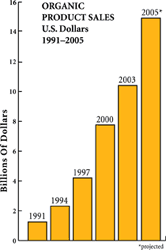
U.S. organic products retail sales are expected to top $21 billion by 2007
All Things Organic� - North America's Only All Organic Conference and Trade Show:
"U.S. sales of organic food and nonfood products during 2003 totaled approximately $10.8 billion, according to the Organic Trade Association�s 2004 Manufacturer Survey released in May 2004. According to survey results, sales of organic foods were approximately $10.38 billion in 2003, up 20.4 percent from the previous year.
Meanwhile, 'non-food' organic products, such as personal care products, nutritional supplements, organic fiber, household cleaners, flowers and pet food, grew by 19.8 percent, to reach $440 million in sales.
U.S. organic food sales have grown between 17 and 21 percent each year since 1997, to nearly triple in sales, while total U.S. food sales over this time period grew in the range of only 2 to 4 percent a year. According to findings from the Organic Trade Association�s 2004 Manufacturer Survey, organic food sales now represent approximately 2 percent of U.S. food sales.
U.S. organic products retail sales are expected to top $21 billion by 2007, based on growth projections from the Organic Trade Association�s 2004 Manufacturer Survey.
Sixty-six percent of U.S. consumers report they use organic products at least occasionally, according to The Hartman Group�s report, Organic Food & Beverage Trends 2004: Lifestyles, Language and Category Adoption released in August 2004. More than 40 percent of those consumers (or 27 percent of the total population) report using organic products regularly. "
Saturday, December 10, 2005
Eating out organic, a new challenge for natural food connoisseurs
CNN.com In-Depth Specials - Eating out organic, a new challenge for natural food connoisseurs:
"Many equate organic with vegetarian, but that is far too limited a definition, according to chef Nora Pouillon, owner of Restaurant Nora in Washington D.C. The well-known establishment with a four-star Mobil rating is the only one in the United States with organic certification.
'I think some people might think it is a vegetarian restaurant,' Pouillon says.
'You know, misinformation is the biggest thing. People really don't understand what organic means. Many feel that organic means vegetarian food -- tasteless, flavorless food that is not very good. The advantage to this is that everybody is very happily surprised.' "
"Many equate organic with vegetarian, but that is far too limited a definition, according to chef Nora Pouillon, owner of Restaurant Nora in Washington D.C. The well-known establishment with a four-star Mobil rating is the only one in the United States with organic certification.
'I think some people might think it is a vegetarian restaurant,' Pouillon says.
'You know, misinformation is the biggest thing. People really don't understand what organic means. Many feel that organic means vegetarian food -- tasteless, flavorless food that is not very good. The advantage to this is that everybody is very happily surprised.' "
The Rise Of Organic Food - Forbes.com
The Rise Of Organic Food - Forbes.com: "Sales of organic food products in the United States have soared to nearly $14 billion from less than $1 billion in the last 14 years, and are expected to rise to $17 billion in the next two years. Whether motivated by food safety scares, health issues or diet concerns, consumers have begun to look for alternative products. "
Friday, December 09, 2005
It would be great if all school kids had the same choice as they do here:
Hellenic News of America: "While fried chicken nuggets and cheeseburgers still reign supreme in most cafeterias, a small but growing number of schools are turning to organic food as a way to improve children's health and fight obesity."
Hellenic News of America: "While fried chicken nuggets and cheeseburgers still reign supreme in most cafeterias, a small but growing number of schools are turning to organic food as a way to improve children's health and fight obesity."
Tuesday, December 06, 2005
Ugh! This is so disgusting!
Sewage sludge legal to use as fertilizer on crops: "It's an outrage: the EPA says farmers can spread human waste sludge on their crops, regardless of what's in the sludge."
Sewage sludge legal to use as fertilizer on crops: "It's an outrage: the EPA says farmers can spread human waste sludge on their crops, regardless of what's in the sludge."
This blew my mind! I use orange zest in recipes alot...I just bought some organic veggie wash from Vermont Soap Works. I wonder if it removes this dye?
Looking for organic vitamins? Grocery store foods are fast becoming a poor source of nutrition:
"Grocery stores, it seems, put far more emphasis on visual appearance than nutritional value. This isn't surprising, since consumers typically select produce based almost entirely on appearance. Oranges from Florida, for example, are frequently dipped in a red dye that gives them a deeper, more saturated orange color preferred by consumers. The only problem is that this orange dye has been banned by the FDA for use in foods due to its proven cancer-causing ability. But the Florida orange industry gets away with using the dye by claiming it's only used outside the orange, not inside. With that strange caveat, the FDA allows its use. "
Looking for organic vitamins? Grocery store foods are fast becoming a poor source of nutrition:
"Grocery stores, it seems, put far more emphasis on visual appearance than nutritional value. This isn't surprising, since consumers typically select produce based almost entirely on appearance. Oranges from Florida, for example, are frequently dipped in a red dye that gives them a deeper, more saturated orange color preferred by consumers. The only problem is that this orange dye has been banned by the FDA for use in foods due to its proven cancer-causing ability. But the Florida orange industry gets away with using the dye by claiming it's only used outside the orange, not inside. With that strange caveat, the FDA allows its use. "
I said to my husband, "organic gas". His reply? "I've got some of that." Too funny, lol!!! Anyhoo, here's the story. Whaddaya think?
California To Sell Organic Gas: "Organic products have become big business for many companies, but California will be the first state to produce and offer organic gasoline for sale.
by George Wolfe
SAN FRANCISCO � California is known for many alternative things that cause the rolling of eyes, but its sponsorship of an organic gasoline program is actually turning heads."
California To Sell Organic Gas: "Organic products have become big business for many companies, but California will be the first state to produce and offer organic gasoline for sale.
by George Wolfe
SAN FRANCISCO � California is known for many alternative things that cause the rolling of eyes, but its sponsorship of an organic gasoline program is actually turning heads."
Subscribe to:
Posts (Atom)


